Thermovision service

Thermovision service

+370 686 21397 andrius@namuinspektorius.lt

Thermovision

Thermovision in combination with tightness

Thermovision
Thermovision


Image with thermovision alone. A large shortcoming of the test – in the case of inappropriate and unfavourable circumstances, some of the defects will simply come unnoticed.


Thermovision along with the building tightness test. This combined test has no drawbacks or inconvenience because the building diagnostics is performed at any time of the year, leaving no room for overlooking any defects. This is an ideal building diagnostic.

Thermovision tests will help you discover or identify:

  • cold bridges;
  • areas prone to condensate or already damaged by it;
  • moisture accumulation areas;
  • dew point areas;
  • properly insulated and uninsulated parts of the buildingd and structures;
  • influence of ventilation openings on your building;
  • Installation quality of the building or parts thereof;
  • most dangerous areas for heat loss, which may already be damaging the building structures;
  • glazing quality of windows;
  • condition of window and door spacings;
  • outdoor air infiltration sites;
  • thermal conductivity (U – W/m2K) or thermal resistance (R – m2K/W) of partitions (exterior walls), roofs, windows, showcases, outdoor doors, with an error of only 7%;
  • points of broken floor heating;
  • technical condition of electricity system;
  • technical condition of mechanical devices (motors, gears, shafts, etc.) or their imminent failure;
  • failures of photovoltaic cells.

All of the above defects mean poor quality work for which you should not have paid a single euro. Don't let yourself be deceived. Thermovision can now be done during the summer, see it in the Thermovision Gallery. The temperature of the outdoor air as virtually no effect during the thermovision test performed in conjunction with tightness test. Read more about thermovision below. Thermovision test is a contactless, non-destructive remote measurement of the surface temperature of the bodies. The thermovision device does not emit any beams or rays, thus it does not affect the tested object. Defective site locations are detected already during the test. If this analysis is not enough, a more thorough analysis is carried out. Thermovision can be used to analyse the difficult-to-access and dangerous points of an object without endangering yourself and others. Thermovision building tests show heat loss in areas in all building structures and entry points of engineering networks. Therefore, it is advisable to carry out a thermal examination of the whole building before starting the building insulation design. Another advantage of the thermovisors is that after you complete your work, you can submit the thermovision images to the customer as a guarantee of the quality of your work, thus avoiding frequent disputes regarding the quality of the work performed.

Thermovision is the most reliable way to find out where heat from your home dissipates.

When thermovisual analysis can be carried out?

Our thermovision equipment can operate at a temperature difference of 13 °C. As a result, high-quality thermovision analysis can be carried out with outdoor temperature of about 0 °C and indoor temperature of + 15 °C. The higher temperature difference practically no longer affects the results, but only creates some inconvenience during work.

How to perform quality thermovision analysis? For high-quality thermovision analysis and the right results you need:

  •  temperature difference of about 15 °C;
  • proper training of the person performing the thermovision test
  •  certification of the person for working with thermal vision equipment;
  •  the available thermal imaging camera must have sufficient resolution and sensitivity to capture thermal images;
  • professional software for correct analysis of thermovision images..

The FLIR E50 thermovision used for thermal imaging has been factory-updated with the following features:

  • touch-sensitive colour LCD display
  • temperature measurement range: -20° C ÷ +650° C;
  • measurement error: ± 2 °C or ± 2%;
  • thermal sensitivity (NETD): <0.03 °C;
  • manual focusing;
  • detector type: FPA, uncolled;
  • resolution up to 320 x 240;
  • spectral range: 7,5 ÷ 13 μm;
  • frame rate: 60 Hz;
  • viewing angle/minimum focusing distance: 25° × 19° / 0.4 m;
  • measurement modes: central point, rectangle with min/max/vid values, isotherms;
  • thermovision image, real photo image, image-in-image view, combination of real-time and thermovision images;
  • correction of reflected temperature, atmospheric and optical system throughput;
  • emission factor: changeable within 0.01 ÷ 1.00 or selected from the material table;
  • memory: removable SD card. Images are saved in JPEG format;
  • laser pointer: displayed in a thermal image;
  • ambient temperature: -20° C ÷ +50° C;
  • protection class: IP54 (IEC 60529).

Thermovision gallery

Trusted by Our Clients

Client testimonials

A professional approach – thermal bridge calculations and dynamic modeling were particularly useful.
Darius V.
Precise calculations made it possible to optimize materials and avoid overpaying for oversized equipment.
Rasa M.
Detailed energy modeling helped precisely achieve the required energy performance class.
Tomas K.

Our Certificates

Our work is carried out in accordance with applicable regulations and the qualifications and certifications we hold.
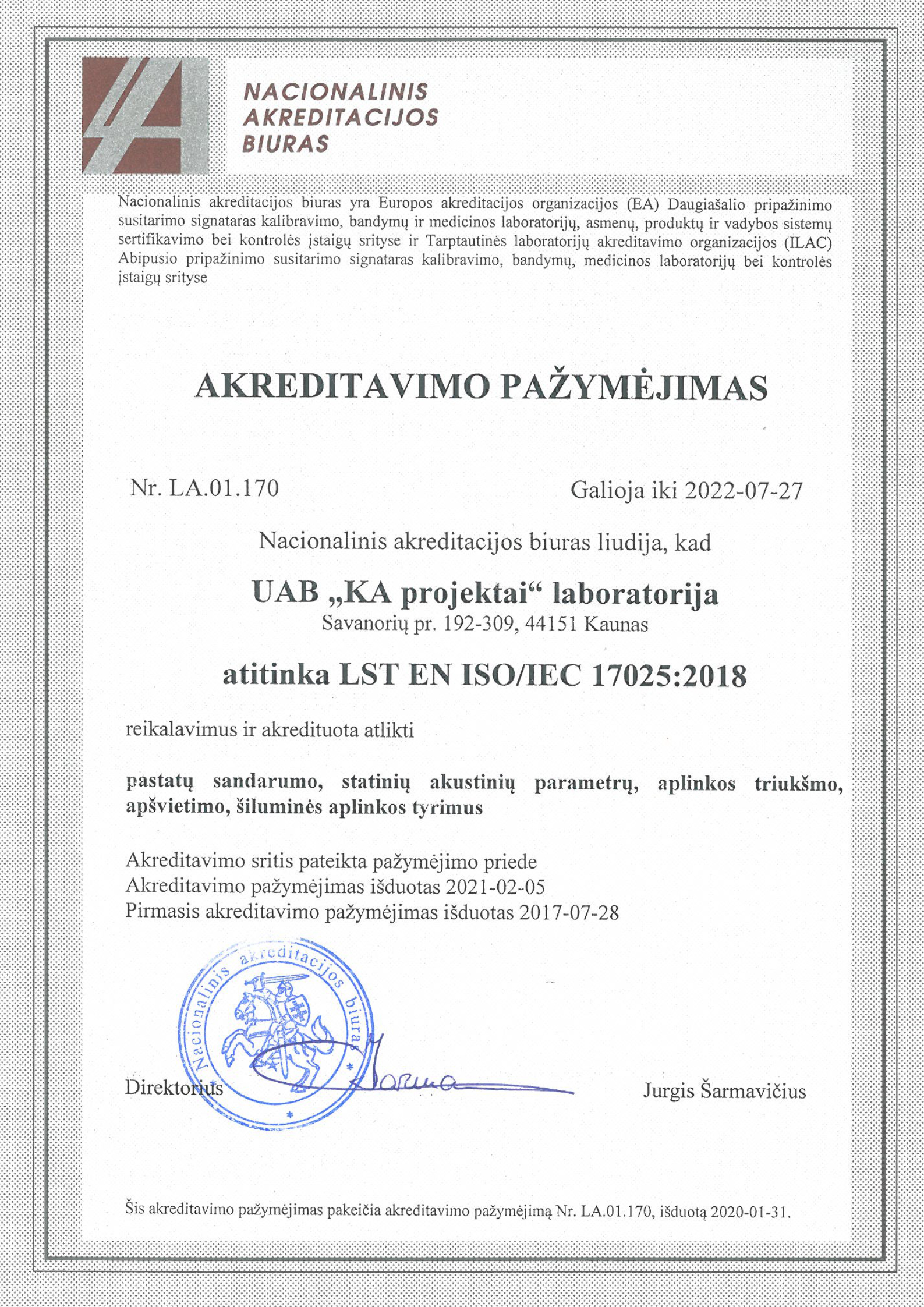
Accreditation Certificate No. LA.01.170

Accreditation Certificate No. LA.01.170

Accredited laboratory performing building airtightness testing, building acoustic measurements, environmental noise measurements, and thermal environment assessments.

View certificate
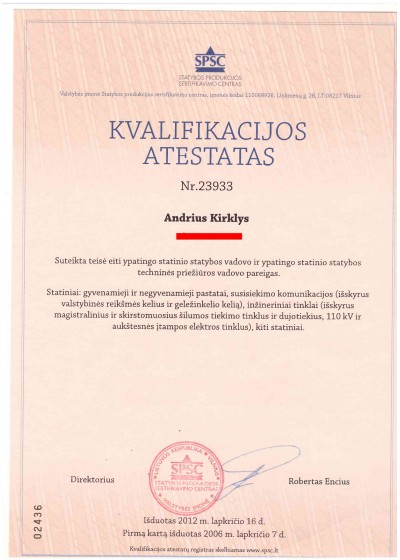
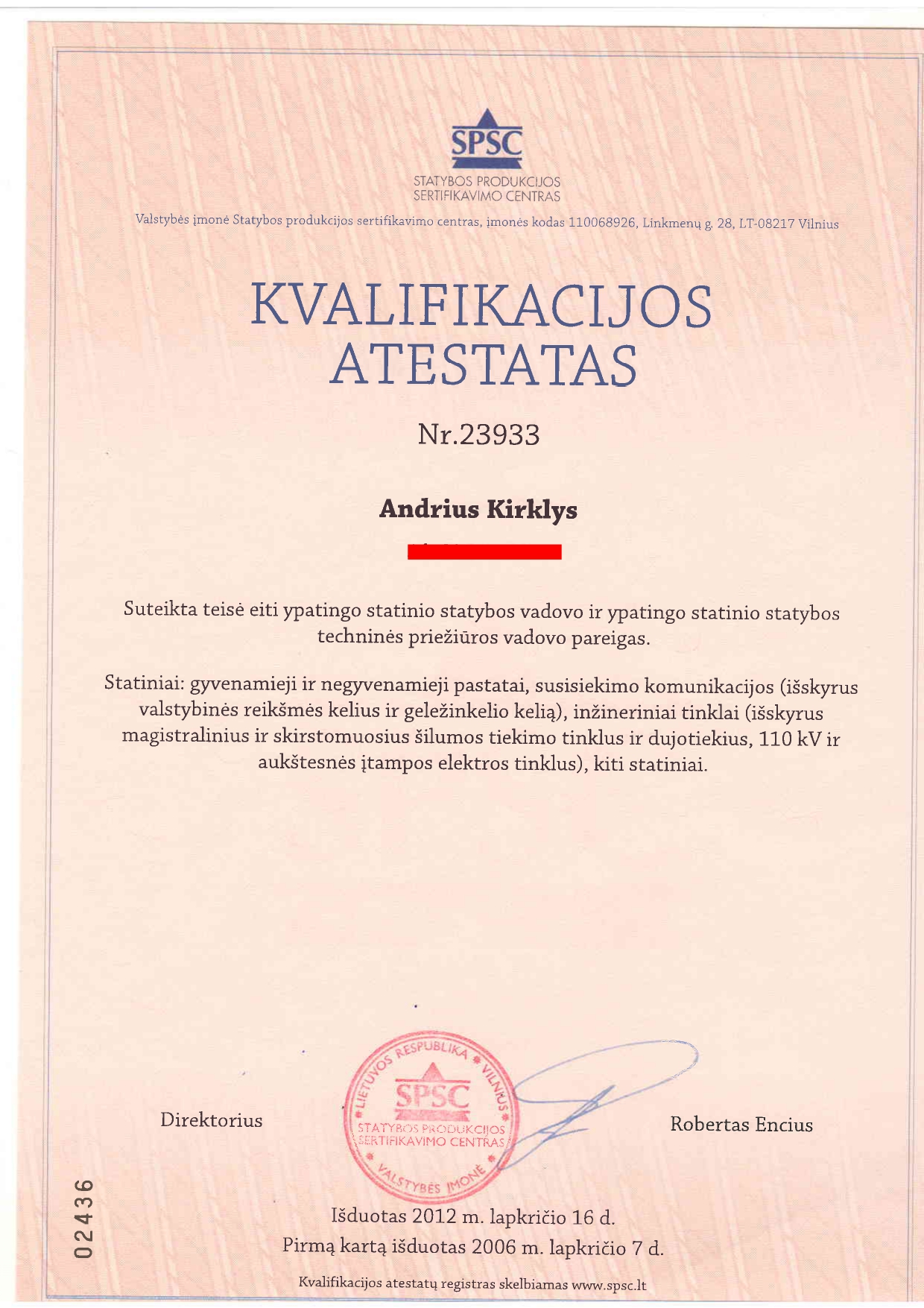
Qualification Certificate No. 23933

Qualification Certificate No. 23933

Assessment of the building’s thermal performance and issuance of energy performance certificates.

View certificate
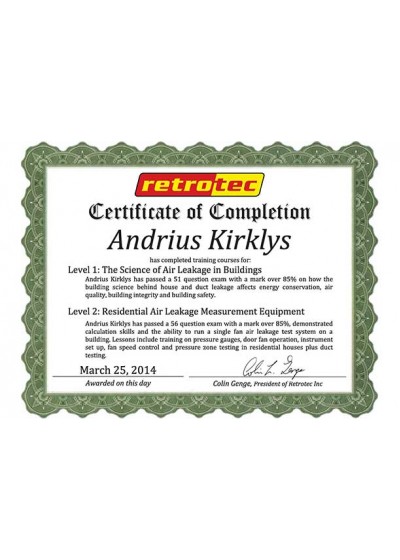
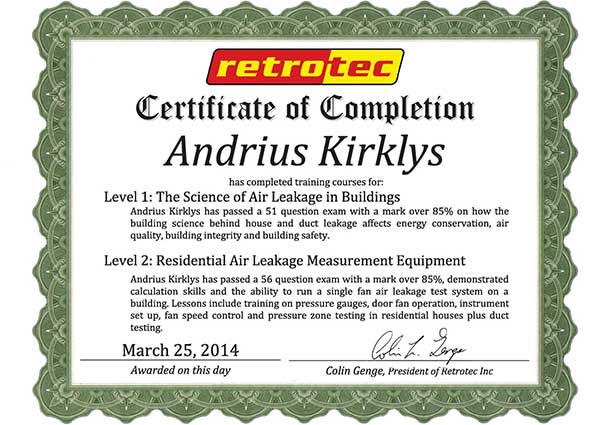
Retrotec Building Airtightness Training Certificate (2014)

Retrotec Building Airtightness Training Certificate (2014)

Certificate confirming the successful completion of training and qualification exams in building airtightness, air leakage detection, and the use of air leakage measurement equipment.

View certificate
ITC Thermography Training Certificate (2013)

ITC Thermography Training Certificate (2013)

Certificate confirming the successful completion of the Infrared Training Center (ITC) introductory thermography course for home inspectors, covering the fundamentals of infrared thermography and its application in building inspections.

View certificate

Frequently Asked Questions

When to start energy modeling?
Having pre-design proposals, preliminary energy calculations can already be prepared.
Are the calculations further refined after the initial assessment?
Yes, after the initial assessment, the energy model is further refined.
Are thermal bridges calculated?
Yes, they are. They typically have a significant impact on the overall project.
Can you achieve cost savings through energy calculations?
Yes, the savings can be significant, as precise calculations prevent unnecessary over-specification of materials.
Does energy design help meet the demand for green electricity?
Yes, with a high-quality energy assessment of the project, the minimum required capacity of the solar power plant will also be calculated.

Let's Talk About Your Project!

Contact us for professional advice and a tailored quote for your building’s energy performance modelling or thermal bridge calculations.

+370 686 21397 andrius@namuinspektorius.lt